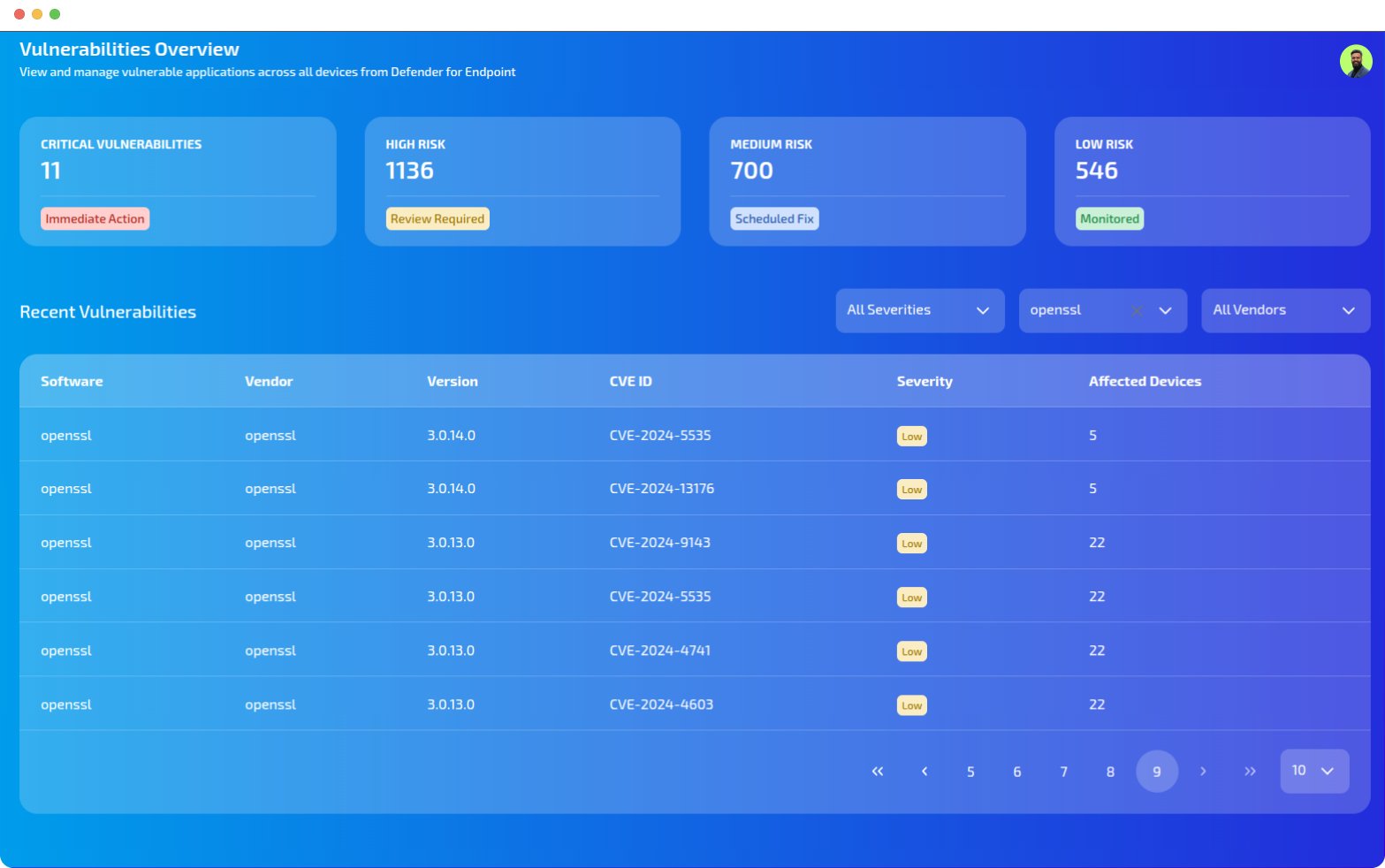
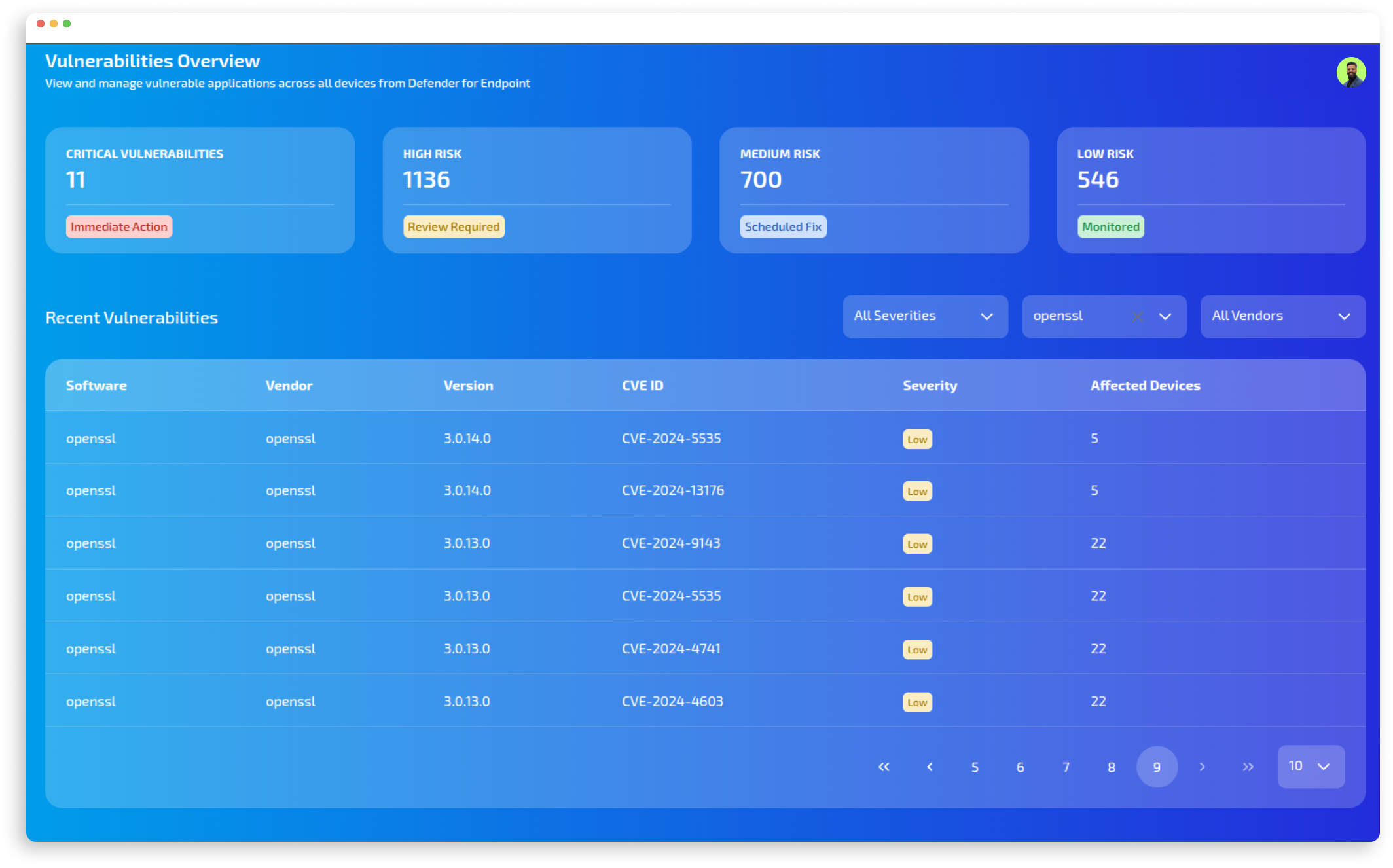
Every major enterprise cyberattack begins somewhere. In the vast majority of cases, that somewhere is an application vulnerability a weakness in software that an attacker can exploit to gain unauthorised access, escalate privileges, exfiltrate data, or deploy malicious code.
Yet despite this, most enterprises have a significant blind spot: they do not have complete visibility into the applications running across their estate, let alone the vulnerabilities within them. This guide explains what application vulnerabilities are, how they are exploited, and what enterprise IT teams need to do to get ahead of them.
What Is an Application Vulnerability?
An application vulnerability is a flaw, weakness, or misconfiguration in a software application that can be exploited by a threat actor to compromise the security, integrity, or availability of a system. Vulnerabilities can exist in the application code itself, in its configuration, in its dependencies, or in the underlying libraries it relies upon.
It is important to distinguish application vulnerabilities from infrastructure vulnerabilities. Infrastructure vulnerabilities exist in operating systems, network devices, and hardware. Application vulnerabilities exist in the software layer the browsers, productivity tools, line-of-business applications, and third-party packages that run on top of the infrastructure. Both matter, but application vulnerabilities are increasingly where attacks begin.
Why Application Vulnerabilities Are the Preferred Attack Vector
Application vulnerabilities have become the dominant entry point for enterprise cyberattacks for several interconnected reasons.
First, the attack surface is enormous. The average large enterprise runs thousands of distinct software titles across its estate. Each application represents a potential attack surface and each version of each application may contain known, exploitable vulnerabilities.
Second, the speed of exploitation has increased dramatically. Research consistently shows that threat actors begin scanning for and exploiting newly disclosed vulnerabilities within hours of public disclosure. The window between a vulnerability being made public and active exploitation in the wild has shrunk from weeks to days sometimes hours.
Third, application vulnerabilities are often easier to exploit than infrastructure weaknesses. A vulnerable browser plugin, an outdated Java runtime, or an unpatched PDF reader can provide an attacker with a foothold that bypasses perimeter defences entirely.
Common Types of Application Vulnerabilities
Understanding the categories of application vulnerabilities is essential for building an effective management programme:
- Unpatched software: Known vulnerabilities for which a vendor patch exists but has not been applied. The most common and most preventable category.
- Misconfigurations: Applications deployed with insecure default settings, excessive permissions, or incorrect access controls.
- End-of-life software: Applications that no longer receive vendor security updates, leaving known vulnerabilities permanently unaddressed.
- Zero-day vulnerabilities: Flaws that are unknown to the vendor and for which no patch yet exists. Particularly dangerous as no immediate remediation is available.
- Supply chain weaknesses: Vulnerabilities introduced through third-party libraries, open-source components, or software dependencies.
- Outdated dependencies: Applications built on deprecated or vulnerable underlying libraries that are not updated when the library receives a security fix.
- Insecure configurations: Applications running with debug modes enabled, unnecessary services exposed, or default credentials unchanged.
The Application Vulnerability Landscape in 2026
The scale of the application vulnerability challenge has never been greater. The National Vulnerability Database (NVD) records tens of thousands of new CVEs (Common Vulnerabilities and Exposures) annually, with numbers increasing year-on-year.
Key trends shaping the landscape:
- Third-party software risk is growing: As enterprises adopt more SaaS tools, open-source components, and specialist applications, the proportion of the estate covered by traditional OS patching programmes shrinks whilst the total attack surface expands.
- End-of-life software persists: Despite best intentions, many organisations continue to run applications beyond their vendor support lifecycle, creating permanent vulnerabilities that cannot be patched.
- Supply chain attacks are increasing: Attackers increasingly target the software supply chain, compromising development libraries and update mechanisms to distribute malicious code at scale.
- AI is accelerating both attack and defence: Threat actors are using AI to automate vulnerability discovery and exploit development; defenders must respond with equally intelligent detection and prioritisation capabilities.
How Vulnerabilities Are Discovered and Disclosed
Understanding how vulnerabilities enter the public domain helps IT teams anticipate and respond effectively.
Security researchers discover vulnerabilities through code review, penetration testing, and automated scanning. Under responsible disclosure practices, they notify the vendor privately before publishing their findings, giving the vendor time to develop and release a patch.
Vendors identify vulnerabilities through internal security testing and bug bounty programmes. When a fix is ready, they publish a security advisory and assign a CVE identifier.
CVEs (Common Vulnerabilities and Exposures) are the standardised identifiers used to catalogue known vulnerabilities. Each CVE record includes a description, severity score (CVSS), and affected software versions. The NVD provides a searchable database of all published CVEs.
Zero-days are vulnerabilities that are exploited in the wild before the vendor is aware or before a patch is available. These are the most dangerous category, as no immediate remediation exists.
CVSS Scoring and Vulnerability Prioritisation
Not all vulnerabilities are equal. The Common Vulnerability Scoring System (CVSS) provides a standardised framework for rating vulnerability severity on a scale of 0 to 10:
- Critical (9.0–10.0): Requires immediate action. Remotely exploitable, no authentication required, high impact.
- High (7.0–8.9): Requires urgent attention within defined SLA timeframes.
- Medium (4.0–6.9): Should be addressed within standard patching cycles.
- Low (0.1–3.9): Lower priority; address within extended timeframes.
However, CVSS alone is insufficient for enterprise prioritisation. A Critical vulnerability in a non-internet-facing, isolated system may represent lower actual risk than a High vulnerability in a customer-facing application processing sensitive data. Effective prioritisation must consider:
- Asset criticality: How important is the affected system to business operations?
- Exploitability in the wild: Is this vulnerability being actively exploited by threat actors?
- Compensating controls: Are there mitigating factors that reduce the real-world risk?
- Exposure: Is the vulnerable system internet-facing or internally accessible only?
Risk-based prioritisation combining CVSS scores with contextual factors enables IT teams to focus remediation effort where it genuinely reduces organisational risk.
The Application Vulnerability Management Process
Managing application vulnerabilities requires a structured, repeatable process:
1. Discover — Maintain a complete, accurate inventory of all applications across the estate. You cannot manage vulnerabilities in software you do not know exists.
2. Assess — Continuously scan the estate against known vulnerability databases. Correlate findings with asset criticality and business context.
3. Prioritise — Apply risk-based scoring to determine which vulnerabilities require immediate action versus scheduled remediation.
4. Remediate — Apply patches, update configurations, isolate affected systems, or deploy compensating controls as appropriate.
5. Verify — Confirm that remediation has been successfully applied and the vulnerability has been closed.
6. Report — Maintain auditable records of vulnerability status, remediation timelines, and compliance posture for governance and regulatory purposes.
This process must be continuous. The vulnerability landscape changes daily as new CVEs are published, new applications are deployed, and existing applications are updated or retired.
Compliance Requirements
Application vulnerability management is a mandated control under multiple frameworks relevant to UK enterprises:
- Cyber Essentials: Requires all software to be kept up to date and high-risk vulnerabilities remediated within 14 days
- ISO 27001 (Annex A): Includes technical vulnerability management as a required information security control
- NIS2 Directive: Requires operators of essential services to implement systematic vulnerability management as part of baseline cybersecurity hygiene
- DORA: Mandates vulnerability identification and remediation processes for financial services firms operating digital infrastructure
- UK GDPR: Requires appropriate technical security measures, which regulators interpret to include timely vulnerability management
Compliance requires not just the practice of vulnerability management, but the documentation of it: policies, processes, remediation records, and exception logs.
Common Gaps in Enterprise Vulnerability Programmes
Even organisations with mature security teams frequently have significant gaps in their application vulnerability programmes:
Incomplete application inventory: Without a full picture of the software estate, vulnerability scanning produces incomplete results. Unmanaged, shadow IT, or legacy applications are routinely missed.
Third-party application blind spots: Most programmes prioritise OS and major vendor software whilst leaving the long tail of third-party applications unmonitored and unpatched.
End-of-life software in production: Applications beyond their vendor support lifecycle continue to run in many enterprise estates, representing permanent, unresolvable vulnerabilities until they are replaced.
Alert fatigue: With thousands of CVEs published annually, IT and security teams can become overwhelmed, leading to prioritisation failures and critical vulnerabilities being buried in a backlog.
Remediation without verification: Many teams apply patches or configuration changes without systematically confirming the vulnerability has been closed, leaving the estate in an uncertain compliance state.
How Camwood Addresses Application Vulnerability at Scale
Camwood’s managed approach to application vulnerability is built around the principle that you cannot remediate what you cannot see.
By providing complete estate-wide application visibility including third-party software, shadow IT, and end-of-life applications Camwood gives IT and security teams the foundation they need for effective vulnerability management:
- Full application discovery: Every software title across the estate, not just OS-level assets
- Continuous vulnerability correlation: Estate inventory matched against live vulnerability intelligence databases
- Risk-based prioritisation: Severity scoring contextualised by asset criticality and business exposure
- Managed remediation: Camwood handles patching, configuration remediation, and lifecycle management on behalf of IT teams
- Compliance reporting: Real-time compliance posture mapped to Cyber Essentials, ISO 27001, and other relevant frameworks
- End-of-life management: Identification and strategic planning for software approaching or beyond vendor support lifecycle
Building an Application Vulnerability Management Programme
For enterprises starting or maturing their vulnerability programme, the following components are essential:
- Asset inventory foundation: A complete, continuously updated record of all applications and software versions in use
- Vulnerability intelligence feed: Integration with CVE databases and threat intelligence sources to stay current on new disclosures
- Prioritisation framework: A documented risk-based model for categorising and scheduling remediation
- Remediation SLAs: Defined timeframes for addressing vulnerabilities by severity class
- Governance and reporting: Regular reporting to CISO, board, and audit functions on vulnerability posture and programme effectiveness
- Exception management: A formal process for documenting, approving, and mitigating vulnerabilities that cannot be immediately remediated
Conclusion
Application vulnerabilities are not an abstract risk they are the practical mechanism through which the majority of enterprise breaches occur. Managing them effectively requires complete estate visibility, a structured and repeatable process, risk-based prioritisation, and the discipline to close the loop with verification and reporting.
For enterprise IT and security teams operating at scale, the challenge is not understanding what needs to be done it is building the capability to do it consistently, continuously, and across every application in the estate.
Ready to close the gaps in your application vulnerability programme? Speak to Camwood about how our managed approach gives enterprise IT teams the visibility and control they need.